
Every review of the Mebak 3 massage gun says roughly the same thing. Good power for the price. Six attachments. Long battery life. Four-point-seven stars. And then they paste the spec sheet. What those reviews skip is the stuff that actually matters when you get it home at 9 PM after a twelve-hour shift and want to use it in the living room without waking anyone up. Or when you realize one of the attachments does not grip as firmly as it should at high speed. Or when you hit the wrong setting and wonder if you just bruised your IT band. So before you add the Mebak 3 to your cart, let me walk you through the parts nobody talks about, and then I will tell you exactly who this gun is built for.
I am Jenna, and I have been working with recovery tools for about eight years, first as a group fitness instructor and now coaching clients one on one who are mostly nurses, parents, and weekend athletes. I have recommended a lot of massage guns, returned a few, and watched clients make expensive mistakes in both directions. The Mebak 3 comes up constantly because it sits right in the middle of the market at a moderate price point. That middle ground is exactly where the trade-offs get interesting.
The Quick Verdict
Real percussion depth at a fair price, but louder than the specs suggest at high speeds, and the attachments need a firm press to seat properly. A smart buy for the right person, not a universal recommendation.
Amazon Check Today's Price →If your foam roller stopped working three weeks in, percussion is probably what you actually need.
The Mebak 3 delivers 12mm amplitude percussion, enough to reach past the fascia and into the muscle belly, at a price well below premium brands. Rated 4.7 stars across nearly 20,000 reviews. Check today's price on Amazon.
Amazon Check Today's Price on Amazon →The Four Things Nobody Mentions in the Star Ratings
Start here, because this is the actual point of an honest review.
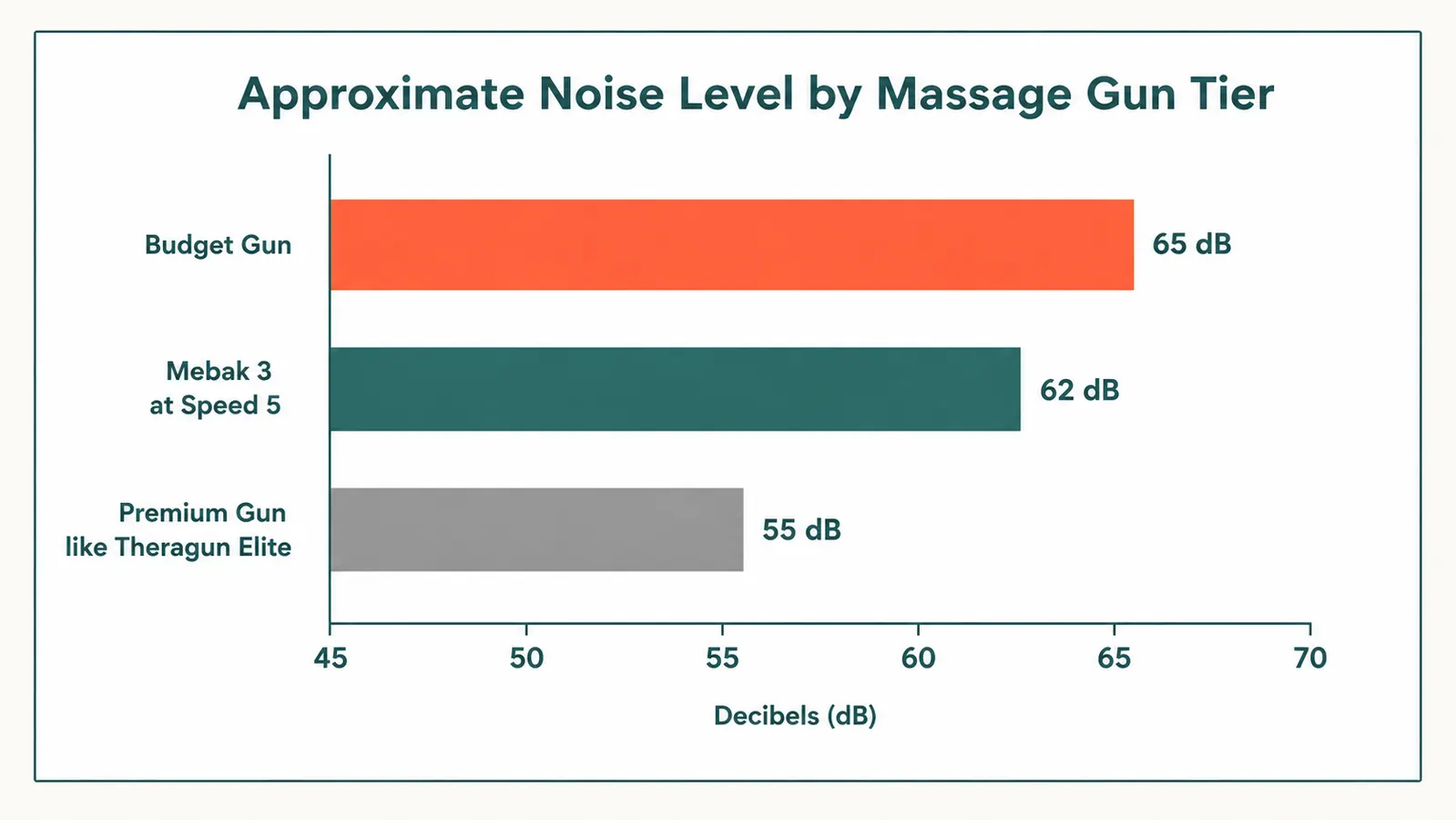
First: the noise. The spec sheet for the Mebak 3 lists something like 40 to 50 decibels. That number is measured at low speed in a controlled setting. At Speed 4 or higher, the real-world noise is noticeably louder, closer to a box fan on high than a quiet hum. If you are sharing a wall, using it in a small apartment, or trying to run a session while a partner is reading nearby, you will feel this. It is not power-tool loud, but it is not the near-silent experience some premium guns deliver. For early morning or late evening use in a shared space, stay at Speed 2 or 3 and you will be mostly fine. Push it higher and the gun announces itself.
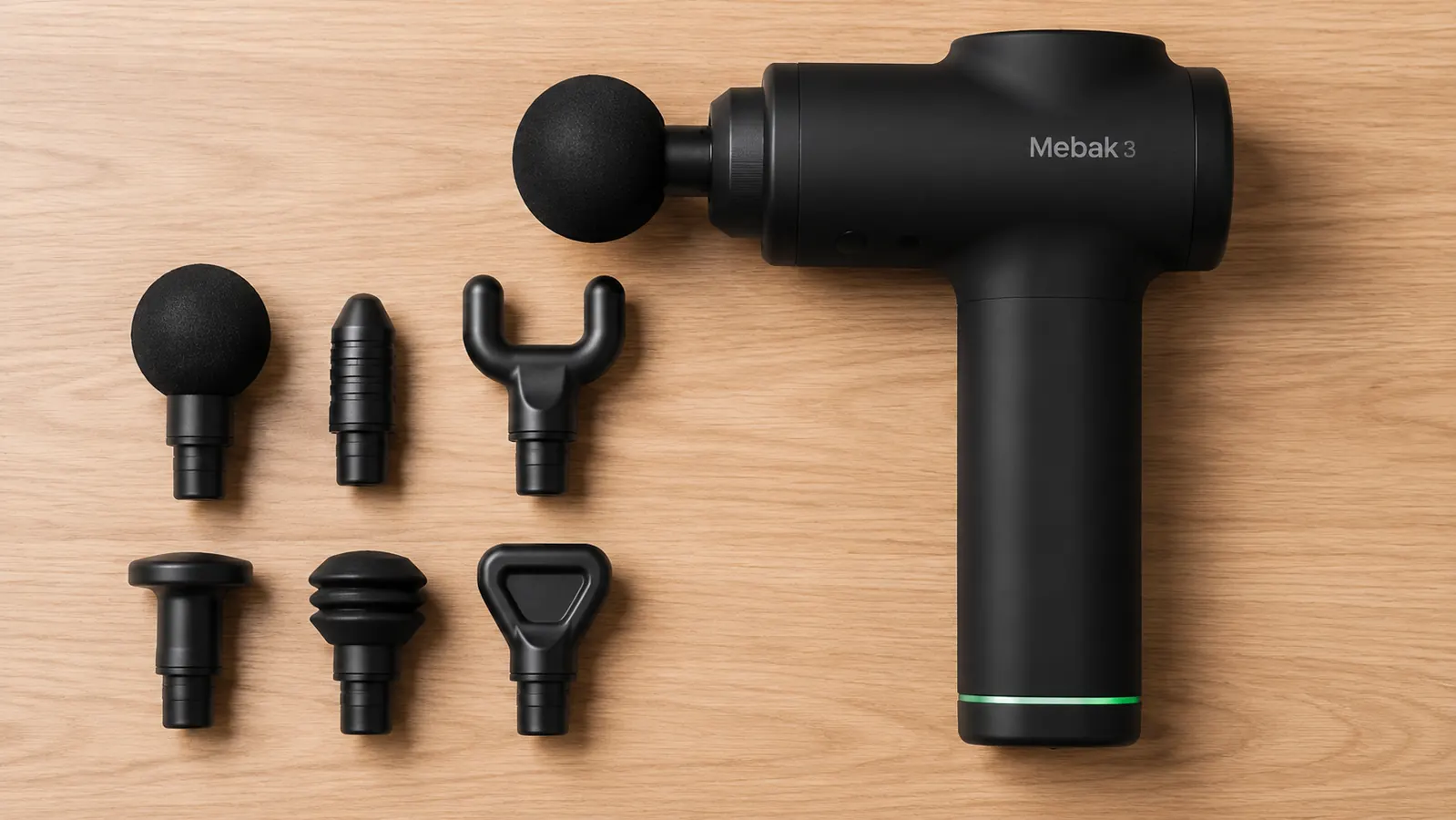
Second: the attachment fit. The Mebak 3 ships with six heads, which is genuinely generous at this price. But two of them, the bullet and the fork, can wobble slightly at the highest speeds if you have not pressed them fully into the receiver. The fix is simple. Push the attachment down with firm pressure until you feel it click, not just until it looks seated. I have had clients bring this gun to sessions convinced something was broken, and every time the attachment just needed to be seated more fully. Once you know this, it stops being a problem. But it would be worth a mention in the instruction booklet, which currently does not flag it.
Third: the learning curve on pressure. Budget vibration massagers do the work for you because the mechanism is gentle enough that you cannot really do damage. The Mebak 3 has enough amplitude and stall force that pressing too hard on sensitive areas, the IT band, the Achilles, or directly on a joint, can cause bruising or soreness that sets you back a day. Most new users run it too hard, in one spot, for too long, and wake up more sore than before. The rule of thumb is two minutes per area maximum, never directly on a joint, and start at Speed 2 before moving up. That context changes how quickly people get good results.
Fourth: battery under real conditions. The rated battery life is generous on paper, but if you are running the gun at Speed 5 or 6 for full sessions every day, you will recharge more often than the marketing suggests. On Speed 2 to 3 for five-to-seven-minute sessions, the battery holds up well across four or five days. Push the top speeds daily and you are probably charging every two to three days. Neither is a dealbreaker, but if you expected a weekly-charge situation, manage expectations.
What Is Actually Inside This Gun and Why It Matters
Here is why the Mebak 3 still earns a real recommendation for the right buyer, despite everything above. The amplitude is 12mm. That number matters more than any other spec. Budget guns in the lower price range typically run 8 to 10mm. The difference between 10mm and 12mm is not subtle. At 10mm, the percussion stays mostly at the fascial layer, which is fine for general vibration but does not reach deep muscle belly tissue. At 12mm, you get genuine percussion that penetrates enough to address tight glutes, upper traps, and the TFL at the hip. That is what separates a recovery tool from a glorified vibrating phone.
The motor is brushless, which means it runs smoother and has a longer lifespan than the cheaper brushed motors in budget guns. Six speed settings give you real range. Speed 1 and 2 are genuinely gentle, suitable for neck, shin, and sensitive areas. Speeds 5 and 6 are aggressive enough for dense tissue like hamstrings and glutes. That spread covers the full recovery toolkit, not just the easy stuff.
The handle angle also deserves a mention because it rarely gets one. The Mebak 3 has an angled grip that lets you reach your mid-back without a full contortion act. If you have ever tried to use a straight-handled gun on your own upper back, you know how quickly your shoulder gives out from the awkward angle. The offset grip on the Mebak 3 makes solo mid-back work actually practical. That single feature alone keeps this gun in my recommendation list for people who work physically demanding jobs and need to self-treat.
How the Six Attachments Actually Perform
Not every head earns its spot in the case, and it is worth knowing which ones do the work before you experiment on a sore muscle.
The round head is the workhorse. Use it on quads, hamstrings, calves, and glutes. It disperses percussion across a wide surface, which is forgiving for beginners and fast for large muscle groups. The flat head is close behind, good for the upper back and chest, areas where you want coverage without the concentrated pressure of the bullet. Together these two heads handle probably 80 percent of the recovery work most people need. The guide on which muscle groups respond best to a percussion gun is worth reading before you start if you are new to this tool.
The bullet head is specific and powerful. It targets trigger points and concentrated knots, particularly in the traps and rhomboids. The trade-off is that it is easy to overdo. Hold it on one spot for more than thirty to forty-five seconds and you will feel it the next day. Use it with intention, not duration. The fork head is interesting for the erector muscles along the spine if you angle it to straddle the vertebrae, though getting the positioning right takes a few sessions to learn. The cushion head is the gentlest option available and is well suited for the neck base, the shins, or anywhere inflammation is still present.
The wedge head is the one most people ignore. I find it useful for the plantar fascia and the anterior tibialis, the muscle along the outer shin that often gets tight in runners and people who stand all day. If you are a nurse or a retail worker with foot soreness, run this head along the bottom of your foot at Speed 2 for two minutes after a long shift. It will not replace compression or ice for acute soreness, but for chronic tightness it helps more than most people expect.
The angled grip on the Mebak 3 lets you reach your mid-back without a contortion act. That one feature alone keeps this gun in my list for people who need to self-treat after physical work.
How It Stacks Up Against the Alternatives
The honest comparison is against three tiers: cheap, comparable, and premium. Cheap means guns in the budget range. Comparable means the Hypervolt Go 2, which sits near the Mebak 3 on price. Premium means Theragun Elite territory at the high end.
Against cheap guns, the Mebak 3 wins on amplitude and stall force. Budget guns stall out when you apply real pressure, which is exactly when you need them to keep going. The Mebak 3 maintains percussion through dense muscle tissue without the motor cutting out. That alone justifies the price gap for anyone using this tool on glutes, hamstrings, or upper back seriously. Against the Hypervolt Go 2, it is a genuine trade-off. The Hypervolt is lighter and quieter, but its amplitude is lower and it stalls more easily under firm pressure. If you travel a lot and want something compact and quiet, the Hypervolt Go 2 might serve you better. If you need penetrating depth for chronic soreness, the Mebak 3 has the edge. The full breakdown lives in the Mebak 3 vs Hypervolt Go comparison.
Against Theragun Elite, the Mebak 3 loses on noise, refinement, and app integration. The Theragun runs noticeably quieter with active noise management, and the 16mm amplitude is a real step up for very dense tissue. But for most people recovering from everyday soreness, teaching fitness, nursing, or weekend athletics, that extra four millimeters of amplitude does not translate into meaningfully better recovery. The noise and weight advantage of the Theragun matters. The extra power, for most bodies, does not justify the price premium. For a full picture of how I used the Mebak 3 in my own routine over several months, the long-term use review covers the specific results by muscle group.
What I Liked
- 12mm amplitude reaches deep muscle tissue that budget guns at 8 to 10mm cannot access
- Angled ergonomic handle makes self-treating the mid-back genuinely practical without a partner
- Six speed settings span from truly gentle (neck, shins) to genuinely aggressive (glutes, hamstrings)
- Brushless motor runs smoother and should last longer than the motors in cheaper guns
- USB-C charging is convenient in 2026 when most devices already use the same cable
- Six attachments cover the full recovery toolkit, especially the round and flat heads for everyday use
Where It Falls Short
- Noticeably loud at Speed 4 and above, enough to be disruptive in shared spaces or late at night
- Bullet and fork attachments wobble at high speed unless firmly seated, which the manual does not explain
- Real learning curve on pressure: too much on the wrong spot causes next-day soreness, not relief
- Battery life drops sharply at highest speeds, closer to two to three days of daily high-speed use
- Soft carry pouch only, no hard case, which limits portability for gym bags that get thrown around
- Heavier than compact travel guns, which becomes noticeable in long overhead or shoulder sessions

Who This Is For
The Mebak 3 is built for people who are physically on, meaning they spend most of their day on their feet, carrying things, or pushing their body, and need real recovery tools that work without a second person in the room. Nurses who finish a twelve-hour shift with locked traps and aching lower backs. Parents who carry toddlers on one hip for six hours straight. Weekend athletes who do not have premium budgets to spend but still need genuine percussion depth for IT band and hamstring recovery. Group fitness instructors who self-treat between back-to-back classes.
You will get value from this gun if you are consistent with it. Two to three sessions per week on problem areas, using the right head, at the right speed, for the right duration. That is the protocol. People who grab it randomly, run it on full power, and move it around constantly will be disappointed. People who learn even the basics of percussion therapy will notice meaningful soreness reduction within two to three weeks.
Who Should Skip It
If you need something truly quiet for early morning use while your family sleeps, spend more and get a Theragun Elite or a Hypervolt 2 Pro. The noise difference is real and worth the price if that specific use case matters to you. If you want an ultra-light travel gun that fits in a small bag and weighs next to nothing, look at compact options in the budget range that prioritize portability over depth. And if your soreness is mild, the general stiffness after a yoga class or a casual 3-mile jog, you likely do not need 12mm amplitude and six speeds. A budget vibration massager or a ten-minute foam roll will probably serve you just as well for less money and no learning curve.
The Mebak 3 is a tool for people who have tried the lighter options and found them insufficient. If you already know foam rolling is not cutting it and you have specific areas that need deeper work, this is a legitimate step up at a price that does not require a lengthy justification to yourself or anyone else.
You have read the downsides. If none of them ruled it out for you, this is probably your gun.
The Mebak 3 is the percussion massage gun I recommend to nurses, parents, and weekend athletes who need real depth without Theragun prices. Nearly 20,000 reviews at 4.7 stars. Check today's price on Amazon before it changes.
Amazon Check Today's Price on Amazon →